It's 2026. Why Did I Build a "Business Model Canvas" Tool?
After going through two entrepreneurial ventures, I believe that the "Business Model Canvas" is the most suitable business thinking tool for inspiring new entrepreneurs.
The "Business Model Canvas" was proposed by Alexander Osterwalder in 2005. Alexander is also the co-founder of the business consulting firm Strategyzer. The Business Model Canvas consists of 9 blocks, posing 9 questions that companies need to answer when designing their business models.
A few days ago, I wrote an article titled "Guide to Filling Out the Business Model Canvas", analyzing each block in detail and explaining how a good Business Model Canvas should be filled out. If you want to understand how to complete a profound Business Model Canvas, you can click the link above to move to the "Filling Guide."
But today, I want to talk about some of the frustrations I experienced while filling out the Business Model Canvas.
No Handy Tools
The method is great, but there are no handy tools. I understand the principles, but what should I use to fill it out?
The Business Model Canvas consists of 9 seemingly simple blocks. However, no matter what tool you use, filling out these 9 blocks is troublesome.
-
[Using Pen and Paper]
- Printing out the fixed 9 blocks on paper and filling them in by hand. You write a dozen words and the block is full. If you write a bit more, it becomes a mess because the grid size is fixed.
- Hard to preserve; you turn around and forget where you lost the paper.
- A dense sheet of paper full of scribbles and corrections—you can't exactly take this sheet to meet investors or take a photo of it to put in your BP (Business Plan), right?
-
[Using Excel/PPT]
- Excel is naturally a grid, and PPT can also draw grids manually. But the grids in Excel/PPT are standard grids where every row is aligned. In reality, the Business Model Canvas needs to reflect the fluidity of business, with intricate, intersecting grids. Adjusting the formatting later will drive you crazy: "Five minutes of business thinking, two hours of formatting adjustments."
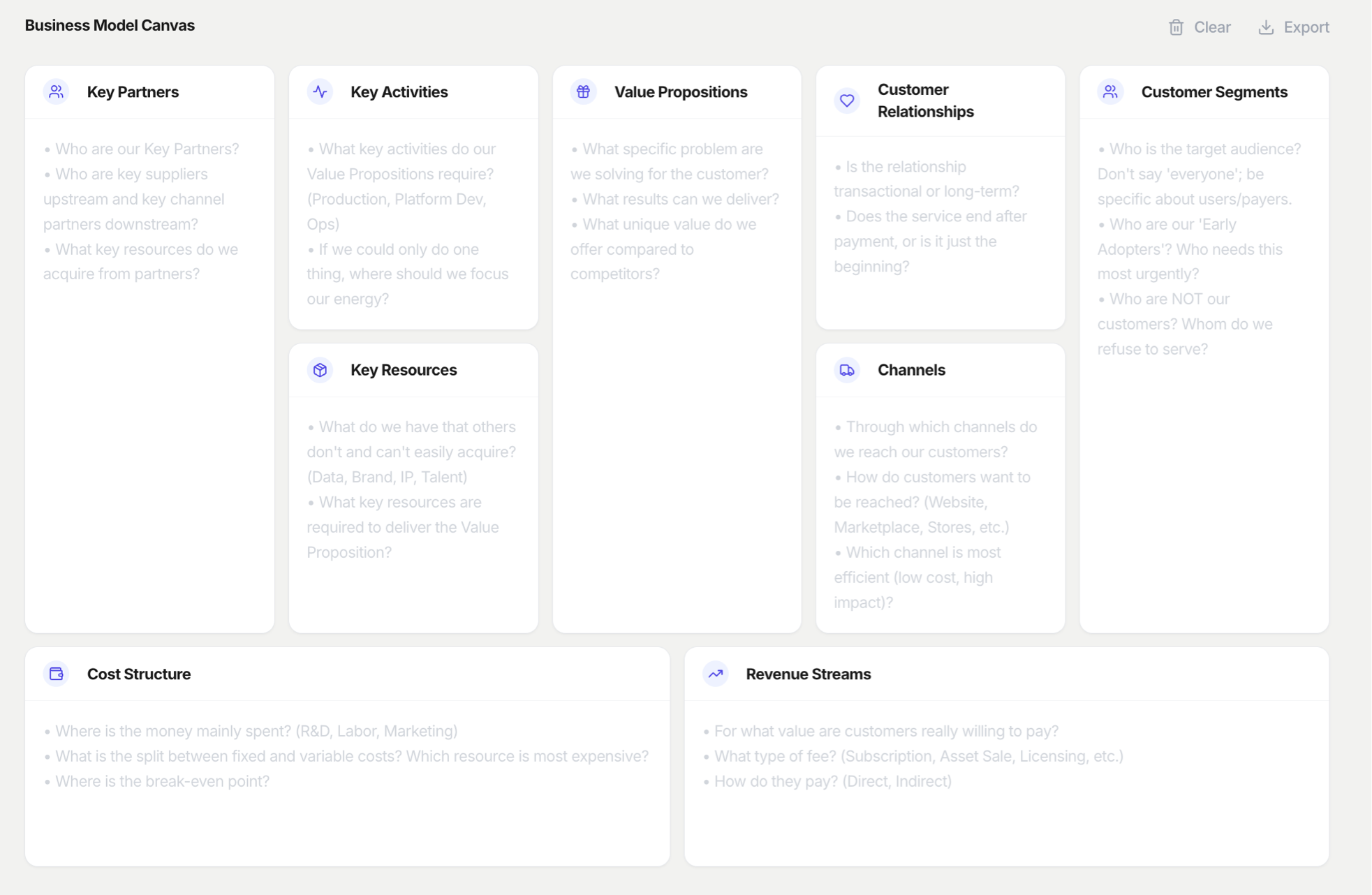
- (The grids of the Business Model Canvas are intersecting)
-
[Using Figma/Canva/Electronic Whiteboards]
- Electronic whiteboard tools offer high freedom; you can draw whatever grid you want. But because the freedom is too high, it often leaves people staring at a blank space, not knowing where to start.
- Some design software provides pre-made templates, but essentially, they are still pre-drawn grids. Once you write too much, you fall back into the nightmare of formatting adjustments.
- Design software is not born for business thinking. Their built-in templates are intended to let users "start designing," not "start thinking." This experience of "just drawing whatever" makes it difficult to achieve the deep purpose of "letting the canvas inspire business model thinking."
So, although I encountered the Business Model Canvas in my university classes, I never found a handy tool to fill it out properly.
What the Canvas Should Be
In my understanding, this Business Model Canvas should look like this:
-
[It should be a "Container" for Logic Frames] The 9 blocks of the Business Model Canvas should be pre-made. We shouldn't need to draw grids by hand, but we need a certain degree of freedom. When we enter longer content, the entire grid should automatically resize to adapt to our input, keeping the layout tidy.
-
[It should be "Deep" enough to Guide Thinking] Not just empty grids, but containing heuristic questions that aid thinking. These questions should be condensed business model methodologies, helping us think better about business models. After all, business models can't be forced out by sheer will; they need to be deliberated step by step.
-
[It should be "Light" enough not to Interrupt Inspiration] No need to adjust formatting, and there shouldn't be dazzling jumps. It should revolve entirely around the business model—an immersive canvas that doesn't interrupt the flow of inspiration.
-
[AI Assistance: Closing the Loop from Idea to Execution] We've said that the most important value of a business model is to turn chaotic thoughts in the brain into actionable directions. In this process, if there is professional AI to help think, it's like having a personal business coach to help us clarify our thoughts faster and provide fresh inspiration when our brains get stuck.
Tools Should Shape Thinking
It wasn't until the rapid development of AI Coding that I discovered the opportunity to create a useful canvas was here. I am a product manager myself, and with AI writing the code, "BusinessModelCraft.com (Business Model Craft) - Business Model Canvas Agent Board" was born. It embodies my many insights into the process of filling out the Business Model Canvas.
The best tool is one that makes you forget its existence and focus only on the creation itself.
The product capabilities of businessmodelcraft.com hope to shape thinking through restrained minimalism.
- [Structured Board] In businessmodelcraft.com, the standard Business Model Canvas board is pre-made. You can start filling it out immediately. It has adaptive capabilities: as you add more content, it automatically adjusts the layout to achieve perfect compatibility.
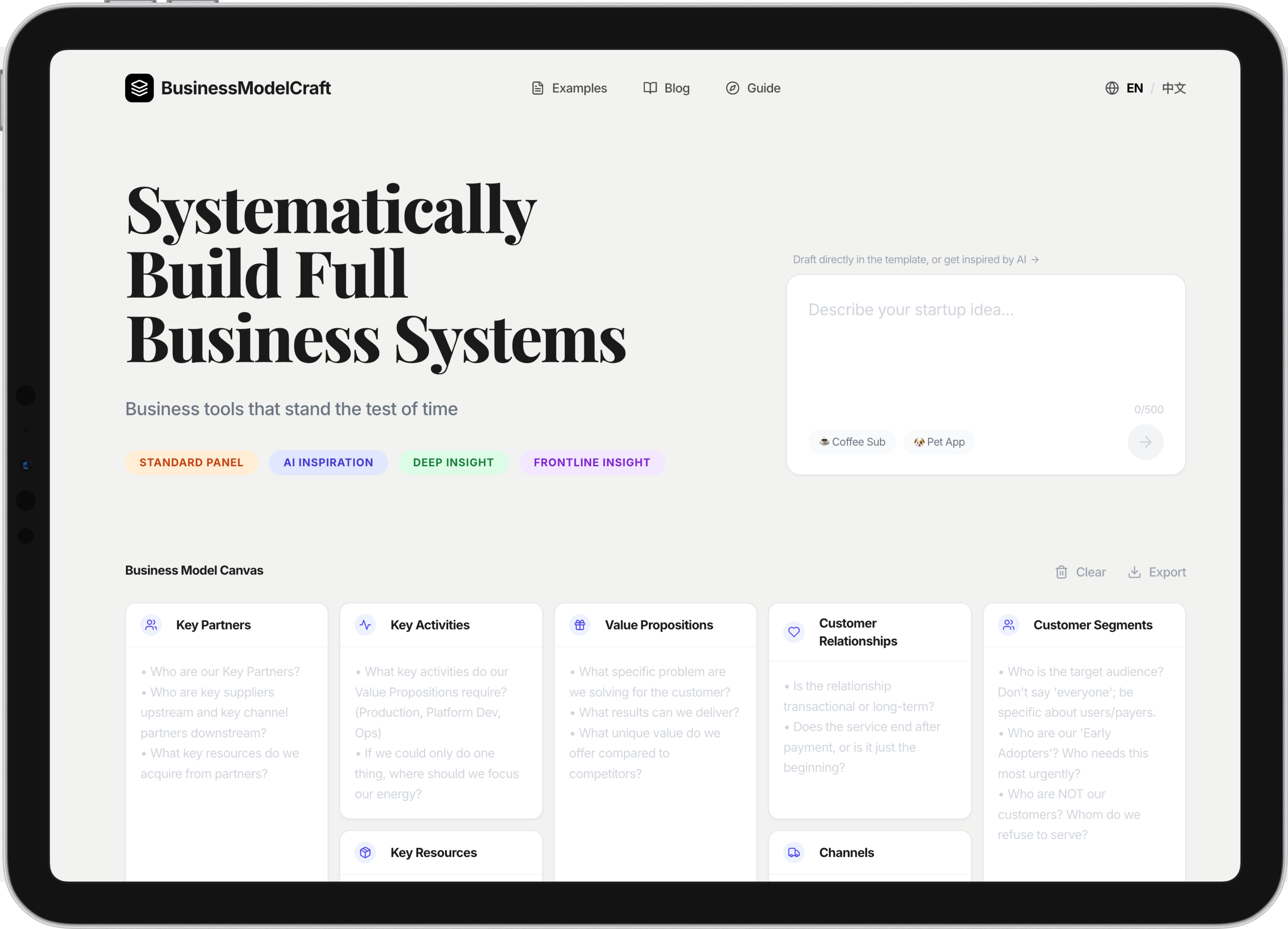
-
[Board Guidance] The Business Model Canvas itself is just a framework; the real value lies in the cognition of "how to fill it out." But a lot of cognition cannot be taught in words alone; it must be gradually understood. In businessmodelcraft.com, I have condensed thousands of words of methodology on filling out the Business Model Canvas into default guidance within the canvas blocks. Using a few questions, it helps entrepreneurs think clearly about how the company should operate. These filling guides are carefully polished to hit the essence of business model thinking.
-
[Canvas Export] After completing the Business Model Canvas, you can export it in high definition directly, making it convenient to use in any PPT or Business Plan.
-
[Minimalist Experience] No account registration required, record directly, don't miss any inspiration; supports multiple languages, perfectly suitable for various occasions.
-
[Cases and Methods] I have pre-loaded a large number of cases and method techniques. This is not just a business thinking tool, but also a customized knowledge base for thinking.
AI is Not a "Ghostwriter," It is a Coach
Beyond the product capabilities, I want to highlight the AI Business Agent of businessmodelcraft.com.
In many AI tools, AI plays the role of a "ghostwriter." However, in business model construction, this is wrong. An entrepreneur's thinking cannot be outsourced.
Entrepreneurs need inspiration. In businessmodelcraft.com, I tuned a dedicated AI Agent based on deep Business Model Canvas filling methodologies.
If you don't have a very clear train of thought for now, this AI Agent can help you establish an initial thinking framework. In the AI inspiration input box, simply describe your startup idea, and the AI will help you fill out a framework on the board, further inspiring your thoughts on "true execution."
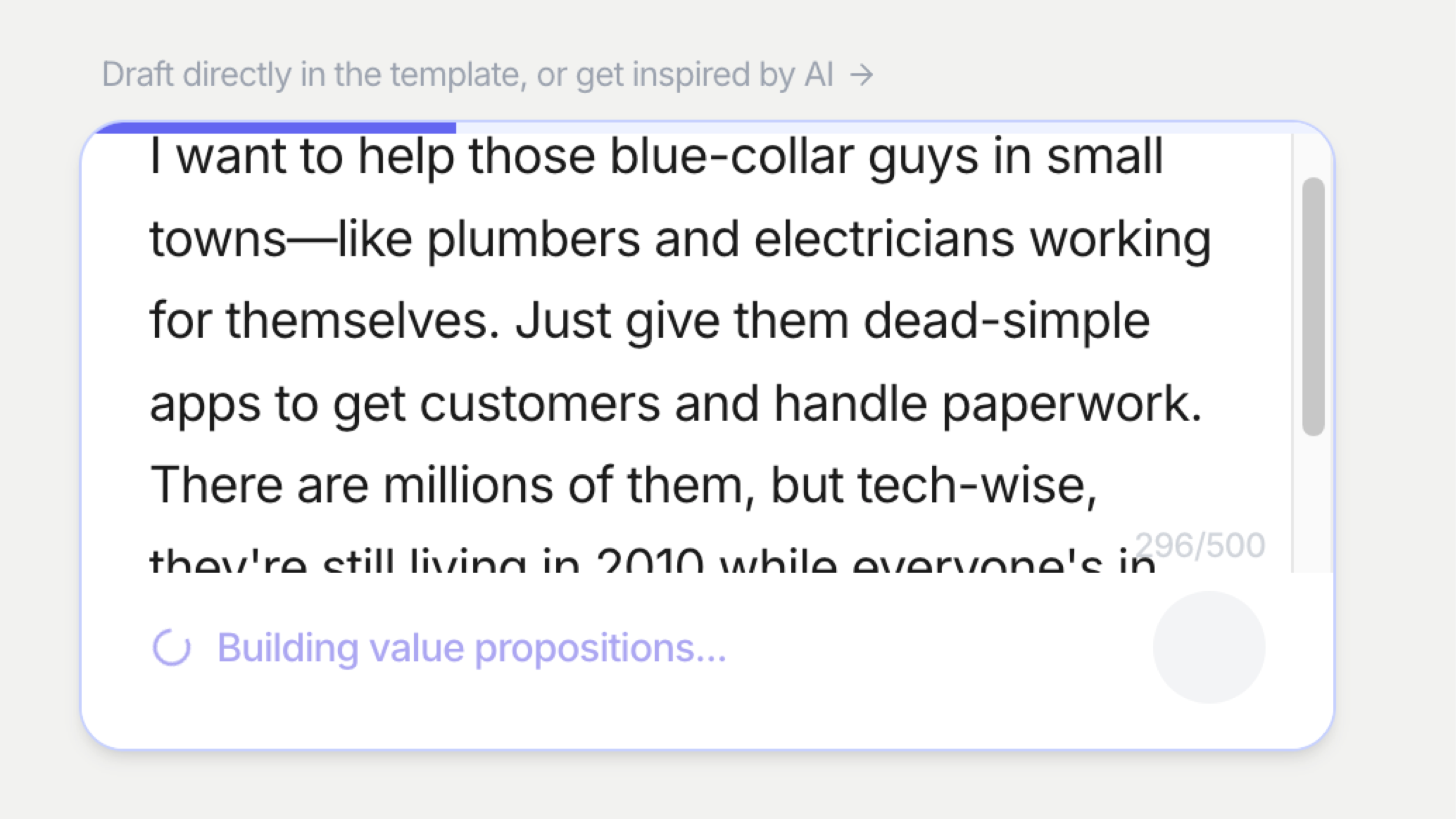
Of course, if you already have a clear idea, it doesn't hurt to let the AI think a bit too; maybe it can spark more new inspiration.
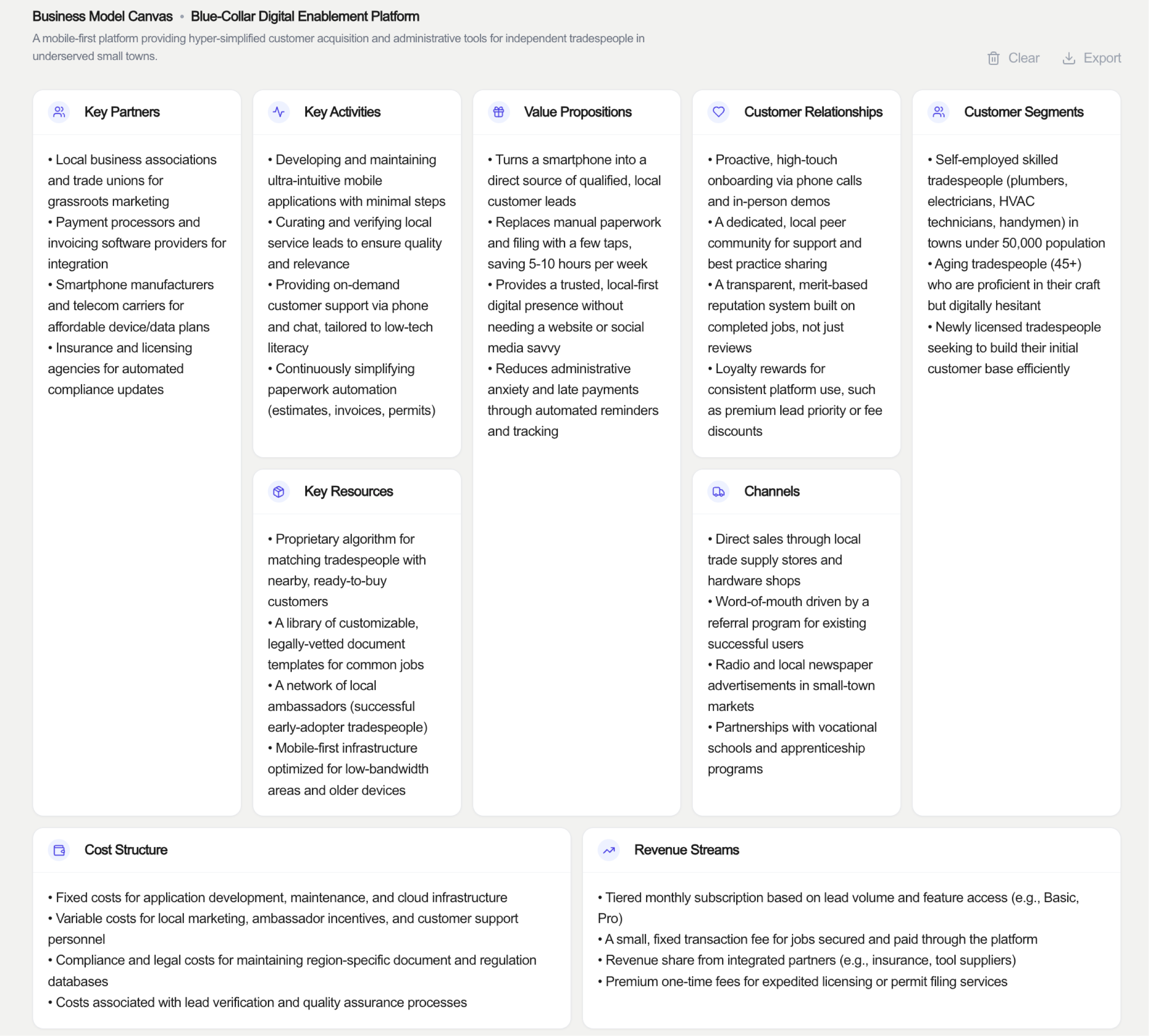
The positioning I gave the Business Model AI Agent in businessmodelcraft.com is that of a coach. It is the minor character in the background, the igniter of the entrepreneur's spark. AI helps inspire you, but the final outline of the business model comes from the entrepreneur's autonomous thinking.
A business model is not a fill-in-the-blank exercise; it is a dialogue with oneself. Now, AI has joined this dialogue.
Thanks to AI
Truly, I have thanked AI more than once.
Thanks to the development of AI, I have the opportunity to turn my ideas into reality with my own hands. Although I have been a product manager for many years, this is indeed the first tool I have "hand-rubbed" (built from scratch) myself. My thinking, my cognition, and my understanding no longer need to be taught in long lectures but are silently integrated into the tool.
I made this product not for financing, not for profit, but only to solve the "small problem" that troubled me, and to provide a little inspiration for more entrepreneurs, helping them save time on formatting and invest their lives in beautiful business thinking.
Welcome everyone to experience it and give suggestions.
businessmodelcraft.com, the Business Model Craft, is right here.